

Could an audit be the silent pillar of your company's stability rather than just a regulatory hurdle to clear? For many business leaders, the requirement for statutory audit compliance in the UAE feels like a complex puzzle of evolving UAE laws and potential operational disruptions. You've likely felt the weight of non-compliance penalties or the worry that a review might stall your team's daily momentum. It's a common concern in a market that demands absolute financial visibility and structural integrity.
We understand that you seek more than just a signature; you want the peace of mind that comes from transparent financial reporting. This guide provides a clear framework for choosing an independent auditor who balances rigorous oversight with a supportive approach. You'll learn how to manage the 50 million AED revenue threshold requirements while ensuring your stakeholders and investors remain confident. We'll outline the steps to secure a partner who brings order to complexity, allowing you to focus on growth while your regulatory obligations are met with quiet, methodical precision.
Key Takeaways
- Understand the core mandate of an independent review to ensure your financial reporting remains transparent and accurate.
- Learn how to manage statutory audit compliance Dubai under the latest Commercial Companies Law and the 50 million AED Corporate Tax threshold.
- Identify the criteria for selecting an auditor who offers genuine neutrality and deep regional expertise to safeguard your company's reputation.
- Discover a methodical framework for the audit process that prioritizes efficiency and minimizes disruption to your core operations.
- Explore the benefits of partnering with a seasoned professional that brings 15 years of stability and historical consistency to your oversight needs.
Understanding the Scope of Statutory Audit Compliance in Dubai
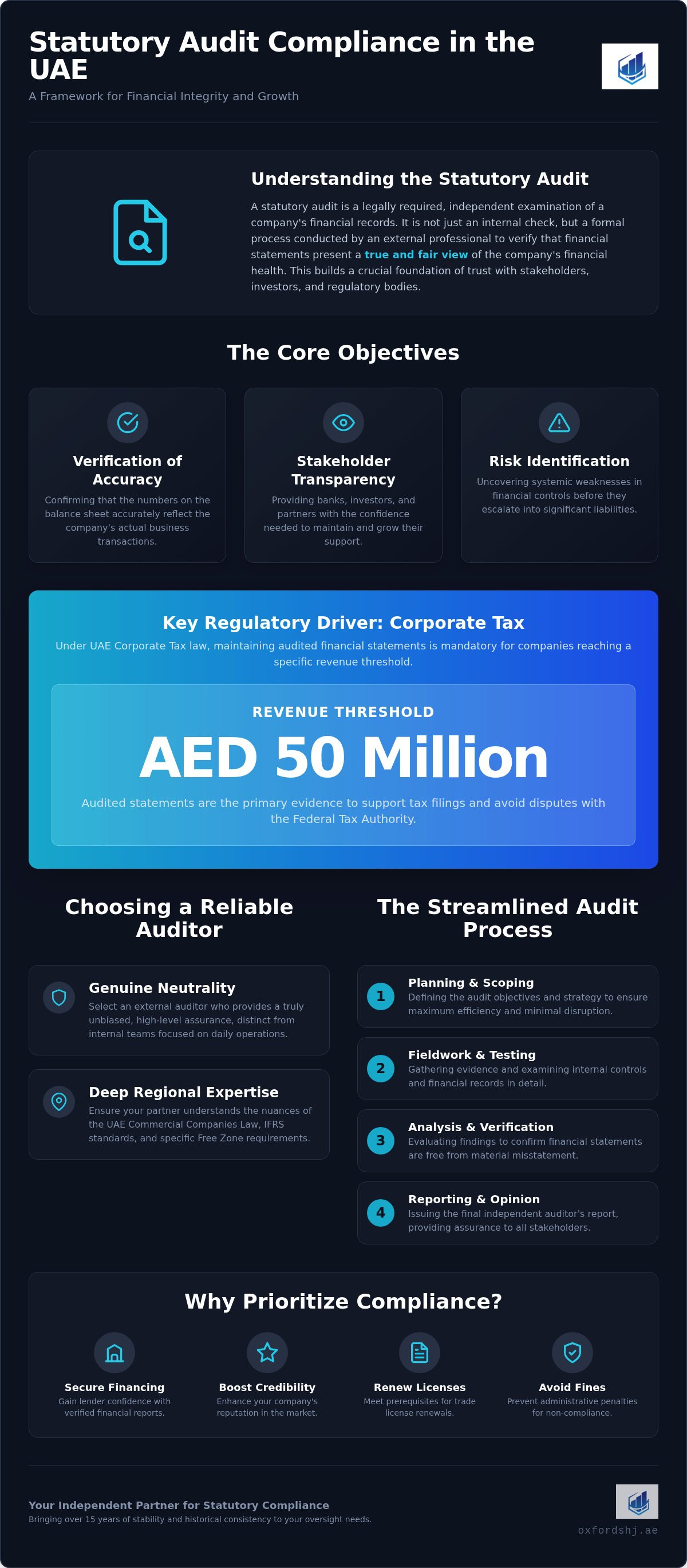
Achieving statutory audit compliance Dubai starts with understanding that an audit is a formal, independent examination of a company's financial records. It isn't merely an internal check; it's a legal requirement designed to provide an unbiased view of a business's financial health. If you're looking for a baseline of what is a statutory audit, it's essentially a process where an external professional verifies that your financial statements represent a true and fair view of your operations. This external perspective is what builds the foundation of trust between a company and its external stakeholders.
The external auditor acts as a neutral observer. Unlike internal oversight teams who focus on daily operational efficiency, the statutory auditor provides high-level assurance to the public and regulatory bodies. Their primary role is to issue an opinion that confirms whether the financial records are free from material misstatements. This distinction is vital. While your internal team keeps the wheels turning, the independent auditor ensures the path you're on is clearly documented and honest.
The Core Objectives of a Statutory Audit
A primary goal of this process is to ensure that all financial reporting aligns with International Financial Reporting Standards (IFRS). This alignment creates a universal language of transparency that shareholders and lenders can rely on. The objectives include:
- Verification of Accuracy: Confirming that the numbers on the balance sheet match the reality of the business's transactions.
- Stakeholder Transparency: Providing banks and investors with the confidence they need to maintain or increase their support.
- Risk Identification: Uncovering systemic weaknesses in financial controls before they become significant liabilities.
Why Businesses Across the UAE Prioritize Compliance
Maintaining statutory audit compliance Dubai is often a prerequisite for renewing a trade license or securing corporate financing. Beyond the legal mandate, it's a strategic move for brand credibility. As the UAE introduces new regulations, such as the mandatory audit threshold for companies with revenue exceeding 50,000,000 AED under Corporate Tax laws, the need for precision has never been higher. Compliance protects your business from administrative fines and positions you as a reliable entity in the regional market. It provides a clean, verified financial baseline that simplifies future growth and ensures your peace of mind.
Essential Regulatory Drivers for UAE Statutory Audits
The regulatory landscape in the UAE is built on a foundation of transparency and accountability. Central to this framework is the requirement for independent oversight, which ensures that businesses operate with integrity. The primary driver for these requirements remains the UAE Commercial Companies Law. This legislation mandates that limited liability companies and joint-stock entities prepare audited accounts annually. It's a measure that safeguards shareholders and maintains the overall health of the national economy.
Adopting International Financial Reporting Standards (IFRS) is another critical pillar. By using these global benchmarks, UAE businesses ensure their financial visibility isn't limited by borders. It's a disciplined approach to reporting that makes complex financial data accessible and reliable for investors and regulatory bodies alike. Following these standards is essential for achieving statutory audit compliance Dubai and maintaining a reputation for honesty and structural integrity.
The Intersection of Statutory Audit and Corporate Tax
The transition into the 2025 and 2026 tax periods marks a significant shift for many businesses. Under current Corporate Tax regulations, companies reaching a revenue threshold of 50,000,000 AED must maintain audited financial statements. These documents aren't just for internal use; they're the primary evidence used to support tax filings. A rigorous audit helps you avoid potential disputes with the Federal Tax Authority by providing a clear, verified account of your taxable income. Engaging in a proactive independent assurance service ensures that your tax positions are grounded in fact, offering a sense of stability as you navigate new fiscal responsibilities.
Free Zone and Mainland Licensing Requirements
Licensing obligations often dictate the rhythm of your auditing cycle. While mainland companies report to the Ministry of Economy, free zone entities must adhere to the specific regulations of their respective jurisdictions. Each zone has its own set of rules regarding submission deadlines and approved auditor lists. Staying ahead of these timelines isn't just about avoiding penalties. It's about maintaining a predictable and comforting flow for your business operations. By treating statutory audit compliance Dubai as a routine part of your annual cycle, you ensure that your trade license remains active without unnecessary friction. Consequences of missing these filing windows can range from administrative fines to the suspension of your company's operating permit.
How to Choose a Reliable Statutory Auditor: A Buyer’s Framework
Selecting an auditor is a decision that defines the structural integrity of your financial reporting. It's about finding a partner who acts as a steady guardian for your business interests. To maintain statutory audit compliance Dubai, you must look beyond basic certifications and evaluate the firm's commitment to neutrality. A reliable auditor should possess no conflicting financial interests that could compromise their unbiased reporting. This independence is what ensures that the final audit report carries weight with investors and regulatory bodies alike.
When evaluating a potential partner, start with the legal foundations outlined in the UAE Ministry of Economy Auditors Legislations. This ensures the firm is fully licensed and adheres to the professional rigor required by national law. While large-scale practices offer a broad reach, boutique firms often provide a more personalized, methodical approach. This deliberate pace allows for a deeper understanding of your specific industry, ensuring that the final report is both accurate and useful for your stakeholders without getting lost in a high-volume corporate process.
Key Selection Criteria for Audit Partners
A firm's track record is a primary indicator of reliability. Look for a history of consistency, such as 15 or more years of regional experience. This longevity suggests a disciplined approach to the craft and a deep understanding of local market conditions. Professionalism is equally vital; the audit team's responsiveness and clarity in communication will dictate the flow of the entire process. You need a partner who makes complex regulatory requirements feel manageable rather than overwhelming, providing a sense of stability throughout the engagement.
Questions to Ask Before Appointing an Auditor
Before finalizing an engagement, ask specific questions about their methodology. Inquire about their approach to risk assessment and how they handle substantive testing during the fieldwork phase. Understanding their process helps you anticipate the level of detail required from your own team and ensures minimal disruption to your daily operations. Finally, ask how they maintain their neutrality throughout the engagement to ensure statutory audit compliance Dubai remains uncompromised. Auditor independence is a non-negotiable standard for trust.
Streamlining the Audit Process for Maximum Efficiency
A well-structured audit doesn't just satisfy a legal requirement; it brings order to your financial ecosystem. Achieving statutory audit compliance Dubai is most effective when the process follows a linear, predictable path. It begins with a dedicated planning phase where we define the audit scope and set realistic timelines. This early clarity prevents the typical rush often associated with year-end reporting, allowing your team to maintain their focus on core business activities.
The fieldwork stage is where the actual testing occurs. A seasoned auditor will work methodically to verify your records, prioritizing transparency and minimal operational friction. Once the testing is complete, a draft report is shared for a collaborative review. This ensures that every finding is understood and that the final independent assurance report accurately reflects your company's financial integrity. If you're looking for a partner who values this methodical approach, explore our independent assurance services to begin your review with confidence.
Preparing Your Business for a Stress-Free Audit
Preparation is the key to a smooth experience. Start by organizing all financial records, bank statements, and supporting documentation well before the auditors arrive. Designating a single point of contact within your finance team ensures that queries are handled promptly and consistently. By pre-empting potential questions through an internal review of your records, you can resolve minor discrepancies early. This disciplined preparation transforms the audit from a disruptive event into a routine, manageable process.
Understanding the Auditor’s Report
The final output of this process is the auditor's report, which provides an opinion on your financial health. An unqualified opinion is the desired outcome, indicating that your statements are fair and accurate. Conversely, a qualified or adverse opinion suggests significant issues that require immediate attention. You might also see an "Emphasis of Matter" section; this doesn't mean the report is negative, but rather highlights a specific point for the reader's attention. Use these findings as a roadmap to strengthen your internal financial controls and ensure lasting stability.
Oxford Auditing Account: Your Independent Partner for Statutory Compliance
Oxford Auditing Account functions as a steady guardian for businesses seeking structural integrity in an evolving regulatory market. With over 15 years of regional experience, we bring a sense of historical consistency to every engagement. We understand that achieving statutory audit compliance Dubai is about more than just checking boxes; it's about providing a clear window into your company's financial health. Our team approaches each review with professional rigor, ensuring that neutrality remains at the heart of our methodology. This disciplined approach allows us to manage complex statutory audit services UAE by focusing strictly on the facts. We position ourselves as a competent partner that brings order to complexity, allowing you to meet regulatory requirements with quiet confidence.
A Legacy of Reliability and Transparency
Stability is earned through consistency and a methodical approach to financial oversight. Having completed over 1,300 audits across the UAE, we've refined a process that prioritizes accuracy and honesty above all else. This established track record serves as a mark of reliability for your stakeholders, lenders, and investors. We provide the independent assurance necessary to build market trust, making the audit process a predictable step toward your long-term goals rather than a source of stress. Our focus remains on delivering thorough reports that eliminate ambiguity. By choosing a partner that values integrity and unbiased reporting, you ensure that your financial statements are grounded in reality and structural visibility.
Next Steps for Your Annual Audit
Transitioning to a more reliable audit partner is a straightforward process when handled with care and professional decorum. We recommend starting your compliance efforts early in the fiscal year to avoid the pressure of looming deadlines and ensure a smooth review. This proactive approach ensures that your statutory audit compliance Dubai is maintained without causing unnecessary disruption to your daily operations. You can reach out to our team for a professional consultation to discuss your specific needs and timeline. We're here to provide a supportive, client-focused experience that guides you through the review process toward a sense of completion. Our goal is to ensure your business remains fully compliant and financially stable, providing the peace of mind you need to focus on your core growth.
Securing Your Financial Future Through Independent Oversight
Establishing a foundation of transparency is a strategic choice that goes beyond meeting legal mandates. By understanding the evolving thresholds of Corporate Tax and the rigor required by the Commercial Companies Law, you position your business for long-term stability. Achieving statutory audit compliance Dubai doesn't need to be an overwhelming hurdle. It's a structured process that, when handled by a neutral partner, provides deep visibility into your operations and builds vital trust with your stakeholders.
A methodical approach ensures that your annual review remains efficient and minimally disruptive. With 15 years of regional experience and over 1,300 completed audits, we provide the independent professional oversight your company deserves. We act as a steady guardian for your financial integrity, bringing order to complex regulatory landscapes. Ensure your business stability with Oxford Auditing Account; contact us today for independent assurance. We look forward to helping you navigate the path ahead with clarity and peace of mind.
Frequently Asked Questions
Is a statutory audit mandatory for all companies in the UAE?
Mandatory requirements depend on your legal structure and annual revenue. Mainland LLCs and many free zone companies must conduct an annual audit by law. Under current Corporate Tax regulations, businesses with revenue exceeding 50,000,000 AED are required to maintain audited financial statements. This ensures that statutory audit compliance Dubai is maintained for tax transparency and regulatory standing. You should verify your specific license obligations with your local authority to ensure full legal adherence.
What is the difference between a statutory audit and an internal audit?
A statutory audit is an independent review conducted by an external firm to provide an unbiased opinion to stakeholders and regulators. It focuses on the accuracy of financial statements. An internal audit is a voluntary process managed by the company to improve operational efficiency and internal controls. While internal reviews help daily management, only an independent statutory audit satisfies the legal requirements for trade license renewals and corporate tax filings in the UAE market.
Which accounting standards are used for statutory audits in Dubai and the UAE?
The UAE primarily utilizes International Financial Reporting Standards (IFRS) for corporate reporting. These global benchmarks ensure that financial visibility remains consistent and transparent for investors, banks, and authorities. Using IFRS allows a business to present its financial health in a language understood worldwide. Auditors verify that all records align with these standards to ensure the structural integrity of the final report and maintain compliance with national commercial laws and tax regulations.
How long does the statutory audit process typically take?
The duration depends on the company's size and the complexity of its transactions. A standard audit for a medium sized business usually takes between two to four weeks from the start of fieldwork to the final report issuance. This timeline assumes that all financial records are well organized and that a dedicated point of contact is available to handle queries. Starting the process early in the fiscal year helps avoid delays during peak reporting seasons and ensures a smooth review.
Can my tax consultant also perform my statutory audit?
Independence is a non negotiable standard in auditing. The auditor must remain neutral and free from conflicting interests to provide a credible opinion. It's standard practice to separate audit functions from other advisory roles to ensure unbiased reporting. Choosing a partner like Oxford Auditing Account ensures that your statutory audit compliance Dubai is handled with the professional rigor and independence required by UAE regulatory bodies. This separation safeguards the integrity of your financial reporting.
What happens if a company fails to comply with statutory audit requirements?
Non compliance can lead to significant administrative penalties and operational challenges. Companies may face fines from the Ministry of Economy or their specific free zone authority. Additionally, failing to submit audited accounts can result in the suspension of a trade license or the inability to renew it. Beyond legal consequences, a lack of audited statements can damage your reputation with banks and investors, making it difficult to secure financing or future growth opportunities in the regional market.
How much does a statutory audit cost for a medium-sized business?
Audit fees are determined by the scope of work and the volume of transactions. Factors like the number of subsidiaries or the industry type influence the professional effort required. We focus on delivering thorough reviews that reflect our 15 years of regional experience rather than providing generic estimates. For a precise assessment of your needs, we recommend a professional consultation to ensure your oversight requirements are met with the necessary rigor and transparency.
What documents are required for a statutory financial audit?
You'll need to provide a complete set of financial records for the fiscal year. Essential documents include:
- Trial balance and general ledger
- Balance sheet and profit and loss account
- Bank statements and reconciliation reports
- Invoices and payroll records

