

What if the annual review you view as a regulatory hurdle is actually the most effective tool for securing your company's future? For many business owners, the requirement for a statutory audit for SMEs UAE feels like a complex administrative burden or a looming risk of FTA penalties. In a market where 82% of small business owners project steady growth through 2026, financial transparency is no longer optional. We recognize the pressure of balancing daily operations with the need for rigorous oversight, especially when rules between Free Zones and the Mainland seem to conflict.
You deserve a process that offers clarity rather than confusion. This guide provides a professional framework to move your SME from basic compliance to long-term strategic stability. We'll walk through the specific 2026 regulations, including the AED 50,000,000 revenue threshold for Corporate Tax, to ensure you achieve full regulatory alignment. By the end, you will understand how to leverage these requirements to improve your creditworthiness for bank loans and gain sharper internal financial oversight. It's time to replace the worry of audits with the quiet confidence of a structured financial path.
Key Takeaways
- Understand the legal framework and necessity of a statutory audit for SMEs UAE to ensure alignment with the latest federal regulations and Free Zone mandates.
- Identify whether your business meets the AED 50,000,000 revenue threshold for mandatory Corporate Tax audits or falls under specific Free Zone filing requirements.
- Discover how audited financial statements act as a bridge to improved creditworthiness and more favorable terms for bank financing.
- Learn how the audit process uncovers structural weaknesses in your internal financial controls, providing a clear path toward operational stability.
- Recognize the importance of the "Independence Rule" and why selecting a neutral partner who does not provide bookkeeping services is vital for reporting integrity.
What is a Statutory Audit for SMEs in the UAE?
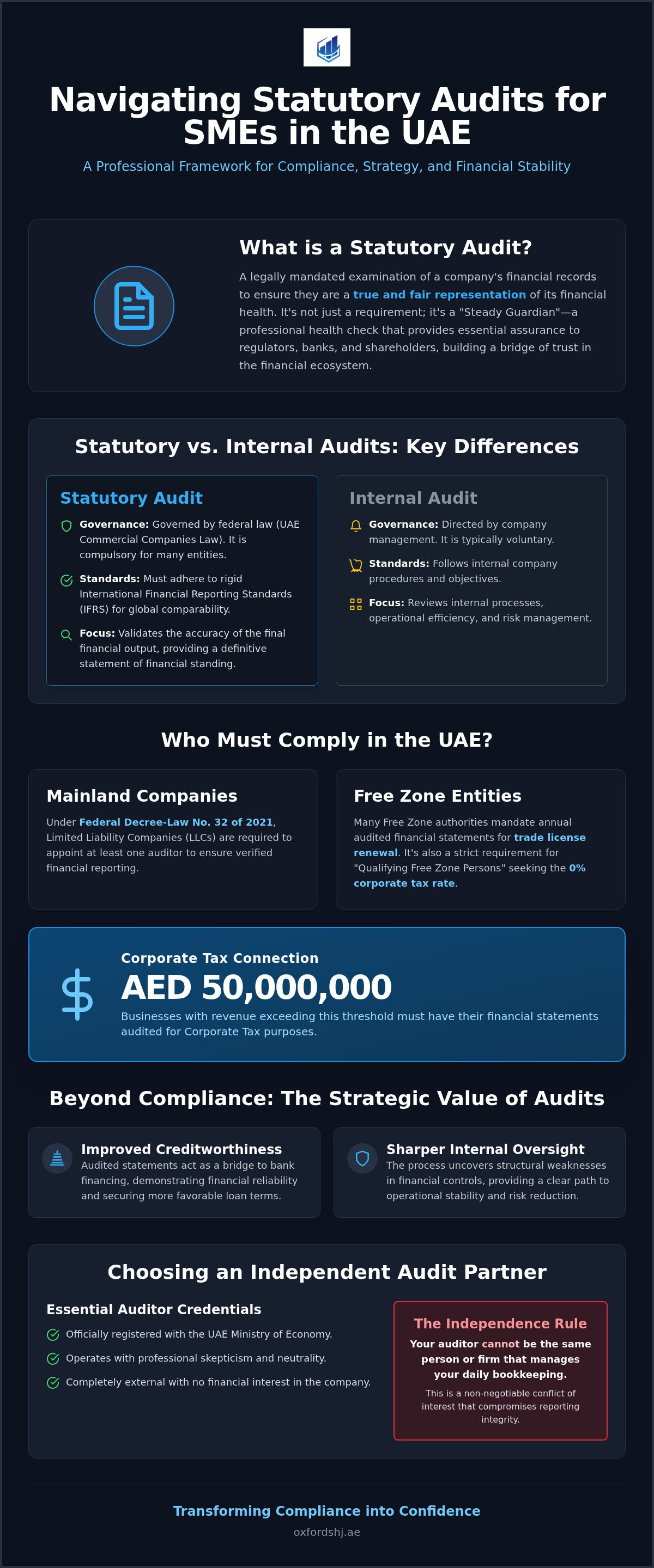
A statutory audit is a legally mandated examination of a company's financial records to ensure accuracy and compliance with established standards. When we discuss a statutory audit for SMEs UAE, we're referring to a formal verification process that confirms your financial statements represent a true and fair view of your business's health. This isn't merely a bureaucratic requirement; it's a mechanism for providing essential assurance to regulators, shareholders, and the public. By validating the precision of your accounts, the audit builds a bridge of trust between your business and the wider financial ecosystem.
We view this process through the lens of a "Steady Guardian." It's a methodical review that protects the structural integrity of your enterprise. Instead of viewing it as a disruption, successful SME owners treat it as a professional health check that ensures growth is built on a solid, verified foundation. This transparency is particularly vital as the UAE continues to strengthen its regulatory frameworks, making clear financial reporting a cornerstone of long-term commercial stability.
The Role of an Independent Auditor
For an audit to hold weight, it must be conducted by an external party with no personal or financial interest in the firm. A statutory auditor operates with a level of professional skepticism, looking beyond the surface to identify discrepancies that might otherwise remain hidden. This neutrality is non-negotiable. Your auditor shouldn't be the same person who manages your daily bookkeeping, as this would create a conflict of interest. In the UAE, these professionals must be officially registered with the Ministry of Economy to ensure they meet the rigorous standards required to sign off on official reports.
Statutory vs. Internal Audits: Key Differences
While both processes involve reviewing financial data, their objectives and legal standing differ significantly. Internal audits are typically voluntary and focus on operational efficiency, risk management, and specific requests from business owners. In contrast, statutory audits are compulsory for many entities and must follow International Financial Reporting Standards (IFRS) or IFRS for SMEs. The following points highlight the core distinctions:
- Governance: Internal audits are directed by management, while statutory audits are governed by federal law.
- Standards: Statutory reviews must adhere to rigid international accounting frameworks to ensure global comparability.
- Focus: Internal reviews often look at internal processes, whereas statutory audits focus on the accuracy of the final financial output.
A certified statutory audit report carries the full weight of legal evidence in the UAE, serving as the definitive statement of financial standing for government authorities and financial institutions alike.
UAE Statutory Audit Requirements: Who Must Comply?
Compliance isn't just about ticking boxes; it's about following the legal architecture of the Emirates. Under the UAE Commercial Companies Law, specifically Federal Decree-Law No. 32 of 2021, Limited Liability Companies (LLCs) are required to appoint at least one auditor. This requirement ensures that the financial narrative of the business is verified by a neutral observer. For many, a statutory audit for SMEs UAE is the primary way to demonstrate this adherence to federal standards. It provides a level of structural integrity that regulators expect from an established business.
Mainland vs. Free Zone Obligations
The rules often vary based on where your license is issued. While mainland entities follow federal decree, many Free Zone authorities have their own specific mandates. For instance, entities in several major zones must submit audited financial statements annually as a prerequisite for trade license renewal. Licensing Authorities act as the enforcers here, ensuring that every business operating within their jurisdiction maintains a high standard of financial transparency. If you're a "Qualifying Free Zone Person" seeking the 0% corporate tax rate, maintaining audited accounts is a strict eligibility requirement, regardless of your annual turnover.
The Corporate Tax Connection for 2026
The introduction of Corporate Tax has fundamentally changed the landscape for SME reporting. By 2026, the Federal Tax Authority (FTA) has established clear benchmarks for when a business must provide verified accounts. Specifically, taxable individuals with annual revenue exceeding AED 50,000,000 are required to undergo a statutory audit for Corporate Tax purposes. This applies to both mainland and non-qualifying free zone entities. Even if your revenue falls below this threshold, the FTA possesses the authority to request audited financials during a formal review to verify the accuracy of your tax returns.
Maintaining these records serves as a protective measure. Audited financials provide a clear, undisputed trail that simplifies the filing process and minimizes the likelihood of costly administrative penalties. For example, failing to maintain proper financial records can result in penalties starting at AED 10,000 for a first offense. Having a verified financial history makes it much easier to resolve potential disputes with tax authorities before they escalate. If you're looking to bring order to your financial complexity, seeking independent assurance services can provide the clarity needed to proceed with confidence.
Beyond Compliance: The Strategic Value of Audited Financials
While meeting legal obligations is essential, the true value of a statutory audit for SMEs UAE lies in its ability to transform raw data into a narrative of credibility. For an SME owner, an audit isn't just a certificate for the authorities; it's a professional endorsement that resonates with banks, investors, and vendors. By adhering to the standards outlined in the UAE Federal Decree Law on Auditing, businesses demonstrate a commitment to transparency that sets them apart in a competitive market. This process provides a definitive anchor for your company's reputation.
Facilitating Credit and Capital
Securing a business loan in the UAE often hinges on the quality of your financial reporting. Most local banks require at least two years of audited financial statements before approving credit facilities for small and medium enterprises. These verified reports provide lenders with the assurance that your cash flow and assets are reported accurately, significantly reducing their perceived risk. Beyond banking, if you're looking to exit your business or invite a new partner, an audit serves as a definitive basis for valuation. Transparency in your books also builds immediate trust with international suppliers, often leading to better credit terms and stronger supply chain relationships.
Enhancing Internal Oversight
The audit process frequently reveals structural weaknesses that are invisible during daily operations. It acts as a forensic deterrent, discouraging internal fraud or embezzlement by establishing a culture of accountability. When an independent expert reviews your transactions, they identify gaps in your internal controls that could lead to financial leakage. Our approach includes providing a "Management Letter" at the conclusion of the review, which offers actionable feedback to help you streamline accounting processes and eliminate recurring errors. Leveraging over 15 years of experience and more than 1,300 completed audits, Oxford Auditing Account identifies these risks with precision, bringing order to complex financial structures.
Owners who aren't involved in the day-to-day bookkeeping find immense peace of mind in this oversight. Knowing that a neutral professional has verified the integrity of the accounts allows you to focus on growth without the underlying worry of financial mismanagement. This strategic stability is what moves a statutory audit for SMEs UAE from a mandatory expense to a vital investment in your company's longevity. It's about moving toward a future where your financial health is never in question.
A Methodical Approach to Audit Preparation for SMEs
Early preparation is the most effective way to prevent the stress of license renewal delays. When you approach a statutory audit for SMEs UAE with a structured plan, the process moves from a source of anxiety to a routine professional review. A typical timeline begins with an initial planning meeting to define the scope, followed by several days of fieldwork where the auditor examines your records. Once the review phase is complete, the final report is issued. Starting this cycle at least three months before your filing deadline ensures you have ample time to address any findings without disrupting your daily operations.
The trial balance and general ledger serve as the map for this journey. These documents must be accurate and up to date before the auditor arrives. If these foundational records are disorganized, the audit cycle takes longer and administrative costs can rise. By maintaining a clean ledger throughout the year, you provide the visibility needed for a smooth, efficient review. This methodical approach ensures that every transaction is accounted for and easily verifiable.
The Essential Document Checklist
Having your documentation organized is half the battle. Auditors require specific evidence to verify the figures on your balance sheet. Digital record-keeping significantly speeds up this cycle, allowing for faster data transfer and review. You should have the following records prepared and easily accessible:
- Financial Statements: Trial balance, profit and loss statement, and balance sheet.
- Reconciliations: Updated bank reconciliations and comprehensive fixed asset registers.
- Regulatory Filings: All VAT returns and your 2026 Corporate Tax filings.
- Employee Records: Accurate payroll records and end of service benefit calculations.
Reconciling Accounts and Schedules
One common hurdle for SMEs is the discrepancy between physical assets and book values. You must match your physical inventory or equipment to what's listed on your balance sheet. If there's a "backlog" of unrecorded transactions, resolve these before the audit begins. This proactive stance prevents the auditor from spending time on basic bookkeeping issues, allowing them to focus on high-level assurance. Our transparent methodology is designed to reduce the stress of this review by providing clear communication at every stage. If you're ready to move toward a more organized financial future, you can schedule a statutory audit with our team to get started.
Choosing an Independent Audit Partner in the UAE
Selecting the right professional to oversee your financial records is a decision that impacts the long-term credibility of your business. A statutory audit for SMEs UAE requires more than just a signature on a document; it demands a partner who possesses the correct registration with the UAE Ministry of Economy and a proven track record of integrity. You need an expert who understands the nuances of the local regulatory landscape, from the specific requirements of individual Free Zones to the overarching federal tax laws that govern the Mainland.
The "Independence Rule" is the cornerstone of a reliable audit. Your auditor shouldn't be the same person who manages your daily bookkeeping. This distinction is vital for maintaining the structural integrity of your financial reporting. While some providers suggest "bundled" accounting and audit services, this practice compromises the neutrality of the review. Unbiased reporting is the only way to achieve the peace of mind that comes with true financial stability. It ensures that the final report is a neutral reflection of your company's actual performance.
The Importance of Neutrality and Transparency
Neutrality acts as a shield for your business. It ensures that the audit report is a transparent reflection of reality, protecting the interests of shareholders and potential investors alike. When an auditor is independent, their findings carry more weight with banks and government authorities. This separation of duties prevents the "self-review" threat, where an individual might overlook their own accounting errors during the audit process. A transparent expert brings order to this complexity without the bias that comes from internal involvement, ensuring that every figure is verified with professional skepticism.
Expertise Born of Experience
Working with a firm that has 15+ years of experience in the UAE provides a significant advantage. The local regulatory environment is unique; it requires a deep understanding of sectoral differences and evolving compliance mandates. Having completed over 1,300 engagements, our team at Oxford Auditing Account has developed a disciplined methodology that prioritizes accuracy and honesty. Our specialized forensic knowledge adds a layer of depth to every statutory audit for SMEs UAE, allowing us to identify subtle financial risks or structural irregularities that others might miss.
This air of established experience allows you to move forward with quiet confidence. We position ourselves as a neutral but highly competent partner that values integrity above all else. Our methodical approach is designed to make complex requirements feel manageable rather than overwhelming. If you're looking for a professional review that prioritizes the facts and protects your business's future, consult with Oxford Auditing for a transparent review of your SME accounts.
Secure Your SME's Financial Future
Moving your business from simple compliance to strategic stability requires a clear understanding of the regulatory landscape. A statutory audit for SMEs UAE is not merely a legal requirement for license renewal or Corporate Tax alignment. It's a powerful tool for enhancing creditworthiness and strengthening internal oversight. By preparing your records early and adhering to International Financial Reporting Standards, you protect your company's integrity in an increasingly transparent market.
Choosing a partner that values neutrality is the final step in this process. Oxford Auditing Account brings over 15 years of UAE experience and a track record of 1,300+ successful audit engagements to every review. Our independent and transparent methodology ensures your financial reporting remains unbiased and reliable. Ensure your compliance and stability with Oxford Auditing Account. You have the vision to grow your business; we provide the verified foundation you need to reach your goals with confidence.
Frequently Asked Questions
Do all SMEs in the UAE need a statutory audit?
Not all SMEs have the same requirements, but most entities do. Mainland LLCs must appoint an auditor under the UAE Commercial Companies Law. Many Free Zones, such as DMCC and JAFZA, mandate annual audits for license renewal. For Corporate Tax purposes, only those exceeding the AED 50,000,000 revenue threshold are strictly required to undergo a statutory audit for SMEs UAE, though smaller firms often choose to for banking and transparency.
What is the deadline for filing audited financial statements in the UAE?
Deadlines depend on your specific jurisdiction and the end of your financial year. For Corporate Tax compliance, the filing deadline is typically 9 months after the financial year ends. If your year ends on December 31, the deadline is September 30. Free Zone authorities often have shorter windows, sometimes requiring submissions within 90 to 180 days. Checking with your specific Licensing Authority is essential to avoid administrative delays and maintain your company's good standing.
Can my in-house accountant perform the statutory audit?
No, your in-house accountant cannot perform this review. A statutory audit must be conducted by an independent third party registered with the UAE Ministry of Economy. This Independence Rule ensures that the report is unbiased and neutral. Using an external partner protects the integrity of your financial statements and provides the assurance that regulators, banks, and shareholders require. It's a critical safeguard for your business’s structural honesty and long-term financial stability.
What happens if an SME fails to submit an audited report on time?
Late submissions can lead to significant financial penalties and operational disruptions. The Federal Tax Authority imposes fines starting at AED 500 per month for late tax returns, while failing to maintain proper records can result in a first-offense penalty of AED 10,000. Additionally, many Free Zone authorities will block trade license renewals until the audited financials are submitted. These consequences can hinder your ability to conduct daily business and damage your long-term creditworthiness.
How much does a statutory audit for an SME typically cost in the UAE?
Audit fees vary based on the complexity of your business, transaction volume, and your specific industry sector. Tiny and small enterprises generally face lower costs than medium-sized companies with more intricate financial structures. Instead of looking for the lowest price, focus on the value of a thorough, independent review. Factors like the quality of your internal record-keeping and the speed of your digital systems also play a role in determining the final investment.
Does the Federal Tax Authority (FTA) require audited accounts for Corporate Tax?
Yes, the FTA mandates audited financial statements for taxable persons with annual revenue exceeding AED 50,000,000. This requirement ensures that the tax figures submitted are verified and accurate. Additionally, any entity wishing to maintain its status as a Qualifying Free Zone Person to benefit from a 0% tax rate must have its accounts audited. Even for businesses below the threshold, the FTA may request audited records during a formal tax audit to verify data.
What is the difference between a statutory audit and a forensic review?
A statutory audit is a general review to ensure financial statements provide a true and fair view for compliance. In contrast, a forensic review is a targeted investigation often triggered by suspicions of fraud, embezzlement, or legal disputes. While a statutory audit for SMEs UAE follows a methodical sampling approach, a forensic review is much deeper and more exhaustive. Both services provide clarity, but they serve different purposes within the oversight lifecycle of a business.
How long does the statutory audit process usually take for a small business?
The duration typically ranges from two to four weeks, depending on the readiness of your financial records. If your trial balance, bank reconciliations, and ledgers are well-organized and digitized, the fieldwork phase moves much faster. Once the auditor completes their examination, there's a final review period before the report is issued. Preparing your documentation at least three months in advance of your deadline is the best way to ensure a smooth, unhurried process.
